
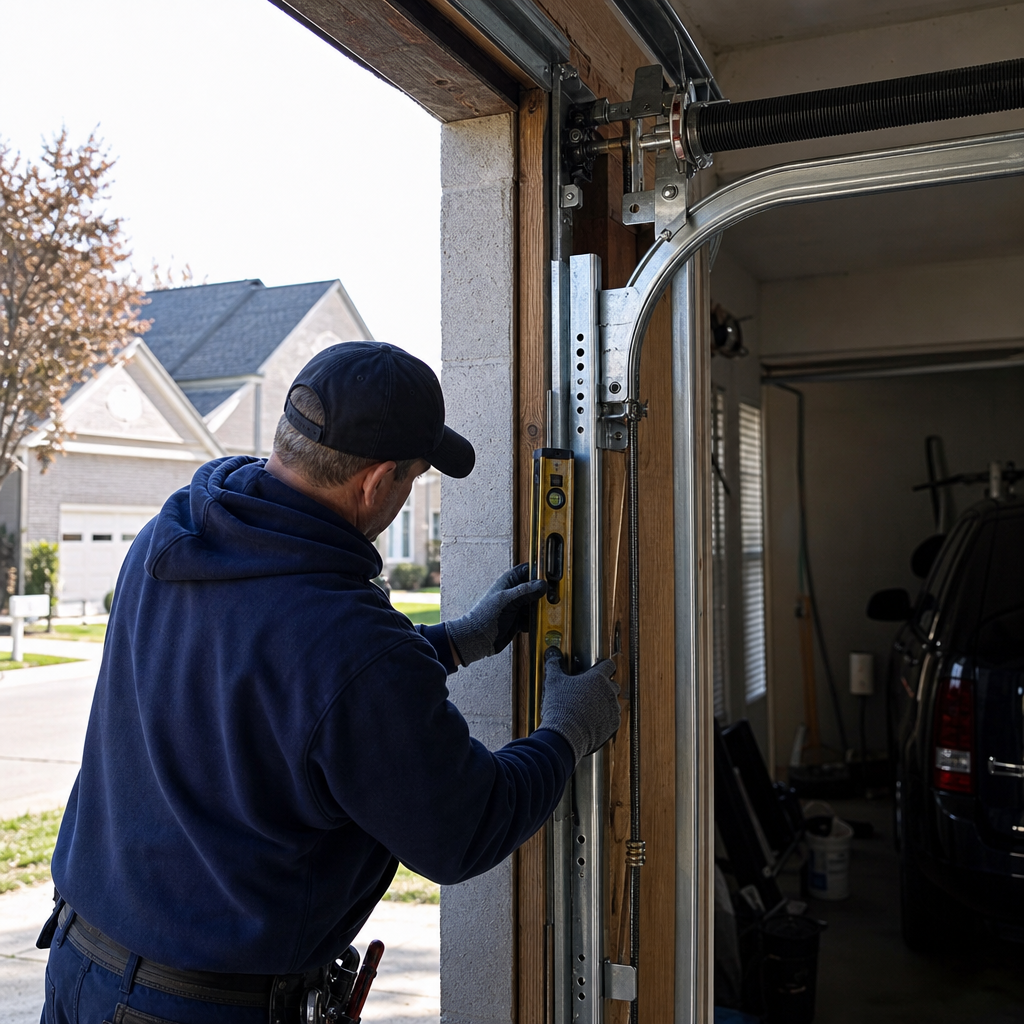
Last updated July 10, 2026
Garage Door Permits, Codes & Inspections in OH: What You Need to Know
A Columbus homeowner in Dublin found out at closing that their 2022 garage door replacement — done by a well-reviewed local company — was never permitted. The buyer’s inspector flagged it, the deal nearly fell through, and the fix cost $1,400 in retroactive inspection fees. The contractor was long gone. In this guide, you’ll learn exactly when Ohio building code and City of Columbus requirements trigger a permit for garage door work, how to protect yourself from liability, and how to verify your contractor did the job right before you write the final check.
Quick Answer
In Columbus, Ohio, a garage door replacement requires a building permit under the Ohio Building Code and City of Columbus regulations, while simple repairs like spring replacement, cable adjustment, or opener troubleshooting typically do not. Permits are pulled through the Franklin County Building Department or your local suburban municipality, and the work must pass inspection before the permit is closed. Homeowners who skip this step risk failed real estate inspections, fines, and forced removal of non-compliant installations.
Table of Contents
- When Is a Garage Door Permit Required in Columbus?
- Repair vs. Replacement: The Permit Threshold
- How to Pull a Permit: Homeowner vs. Contractor
- Franklin County vs. Suburban Municipalities
- What a Failed Inspection Looks Like
- How to Verify a Completed Permit in Property Records
- Permit Costs and Inspection Timelines in Columbus
- Common Mistakes to Avoid
- When to Call a Professional
- Frequently Asked Questions
- The Bottom Line
When Is a Garage Door Permit Required in Columbus?
The Ohio Building Code, adopted statewide with local amendments, classifies garage door installation as structural work that alters the building envelope. In Columbus, this means any new garage door installation or full replacement of an existing door triggers a residential building permit requirement.
Here’s what Columbus homeowners need to understand: the permit isn’t about the door itself — it’s about how the door integrates with the structure. The opening size, header load calculations, wind load ratings, and safety device placement all affect the building’s structural integrity and occupant safety. The City of Columbus Building and Zoning Services Department enforces these standards through the permitting process.
Specific situations that require a permit in Columbus include:
- Installing a garage door on a new construction home or addition
- Replacing an existing door with a different size or style that modifies the rough opening
- Converting a carport to an enclosed garage with a new door
- Upgrading to a heavier door material (for example, switching from a standard steel door to a solid wood or insulated composite door that changes structural loads)
- Installing a garage door on a detached accessory building over 200 square feet
Wind load requirements are particularly relevant in Columbus. Central Ohio experiences severe thunderstorms and occasional straight-line wind events that can exceed 70 mph. The Ohio Building Code references ASCE 7 wind load standards, and garage doors in Columbus must meet or exceed the pressure ratings for the local wind speed zone. We’ve seen garage door installations in Columbus where homeowners wanted oversized carriage-style doors with decorative hardware — beautiful, but the increased surface area demands heavier-duty tracks and reinforced jambs that inspectors verify carefully.
One detail competitors rarely mention: if your home is in a Columbus historic district, such as German Village or Victorian Village, you may face additional design review requirements beyond standard building permits. The Historic Resources Commission reviews exterior alterations, and garage door changes visible from the street can require their approval.
Repair vs. Replacement: The Permit Threshold
This is where Columbus homeowners get tripped up — and where unscrupulous contractors exploit confusion. The permit threshold isn’t about how much you spend or how many parts get swapped. It’s about whether the work constitutes a “replacement” versus a “repair” under code definitions.
Repairs that typically do NOT require a permit in Columbus:
- Spring replacement (torsion or extension springs)
- Cable repair or replacement
- Roller, hinge, or bracket replacement
- Opener repair, motor replacement, or safety sensor adjustment
- Track realignment or section replacement (limited to one or two panels)
- Weatherstripping, bottom seal, or trim replacement
- Remote programming or keypad installation
Work that DOES require a permit:
- Complete door replacement (all panels, new tracks, new hardware)
- Changing the door dimensions or switching from single to double door configuration
- Structural modification to the header, jack studs, or rough opening framing
- Converting from a tilt-up door to a sectional roll-up system
- Installing a fire-rated door between garage and living space (separate fire assembly permit)
In our 20 years of hands-on experience across Columbus neighborhoods from Bexley to Powell, we’ve encountered homeowners who were told by other companies that a “full system replacement” was just a repair. If the tracks come out, the springs get upgraded to a different size, and the door panels are all new — that’s a replacement, and it needs a permit. We’ve had to remediate jobs in Upper Arlington where the previous installer used residential-grade hardware on a heavy Wayne Dalton wood door, and the weight imbalance created a safety hazard that a permit inspection would have caught.
The rule of thumb we give Columbus homeowners: if you’re writing a check for more than $1,500 and the description includes “new door” or “complete system,” ask about the permit before work starts.
How to Pull a Permit: Homeowner vs. Contractor
You have two paths to permit compliance in Columbus, and the choice carries significant legal implications.
Option 1: Homeowner Pulls the Permit
As the property owner, you can apply for a residential building permit yourself through the City of Columbus Building and Zoning Services portal or in person at 111 N. Front Street. You’ll need:
- A completed permit application with project scope description
- Property address and parcel ID
- Detailed door specifications (manufacturer, model, size, wind load rating)
- A site plan or sketch showing door location on the structure
- Payment of permit fees (typically $75–$150 for residential garage door work)
The downside: when you pull the permit, you become the legally responsible party for code compliance. If the installation fails inspection, you’re on the hook for corrections. If a worker gets injured on your property during the job, your homeowner’s insurance becomes primary. We’ve seen this go wrong in Westerville, where a homeowner pulled their own permit to save $100, then faced a failed header inspection that cost $800 to remediate — with no recourse against the installer who’d already been paid.
Option 2: Licensed Contractor Pulls the Permit
This is what we recommend, and it’s what we do on every qualifying job at Empire Garage Door Installation Columbus home. When your contractor pulls the permit:
- They become legally accountable for code-compliant installation
- Their insurance and bonding cover worker injuries and property damage
- Failed inspections are their financial responsibility to correct
- You have a permit record tied to their license, creating accountability
- Future buyers can verify professional installation through public records
Here’s the critical step many Columbus homeowners miss: verify the permit is actually pulled before work begins. Ask for the permit number and confirm it in the city’s online system. A legitimate contractor has no problem with this. In our experience, the contractors who rush to start without paperwork are the same ones who cut corners on safety cable installation or use undersized headers.
Steven personally handles permit applications for every replacement job we take in Columbus. It’s built into our process, not treated as an afterthought.
Franklin County vs. Suburban Municipalities
Not every garage door job in the Columbus metro falls under City of Columbus jurisdiction. The permitting authority depends on your property’s location, and the processes differ in ways that matter for timeline and inspection scheduling.
City of Columbus
Covers properties within Columbus city limits, including neighborhoods like Clintonville, Merion Village, Franklinton, and the Near East Side. Permits are issued through Building and Zoning Services. Inspections are typically scheduled within 3–5 business days of request, and the department offers online scheduling. Columbus uses a combination of in-house inspectors and contracted third-party agencies for residential work.
Dublin
Dublin operates its own Building Standards department with stricter review timelines. Garage door permits here often require a pre-construction plan review that adds 5–7 business days before issuance. Dublin inspectors are particularly thorough about header sizing and fastener schedules — we’ve found they check lag bolt penetration depth into framing members, not just presence. The Dublin homeowner from our opening hook learned this the hard way: the city’s records showed no permit history for their address, and the retroactive process required full removal of trim to expose framing for inspection.
Westerville
Westerville uses the Franklin County Building Department for plan review but conducts its own inspections. Their system creates a hybrid timeline: permit issuance through county channels, inspection scheduling through Westerville directly. One quirk — Westerville requires 24-hour advance notice for inspections, and same-day requests are rarely accommodated. If you’re on a tight closing timeline, this matters.
Upper Arlington
Upper Arlington maintains independent building department control with some of the most rigorous residential inspection standards in Central Ohio. Their inspectors verify garage door opener force settings with calibrated testing equipment, not just visual checks. We’ve had Upper Arlington jobs where the inspector required documentation of opener safety reversal force in pounds, which meant testing with a scale and recording results. The city also enforces strict setback and aesthetic guidelines in certain zoning districts.
Franklin County Unincorporated Areas
Properties in Franklin County but outside municipal boundaries — parts of Grove City-adjacent areas, certain tracts near Reynoldsburg — fall under county jurisdiction exclusively. The Franklin County Building Department handles permitting and inspection, typically with longer lead times (7–10 business days for inspection scheduling) but less stringent aesthetic review.
How to determine your jurisdiction: Enter your address in the Franklin County Auditor’s property search. The taxing district and municipality fields show who has building authority. When we schedule garage door repair in Columbus area homes, we verify jurisdiction during our initial call to ensure proper permitting.
What a Failed Inspection Looks Like
After two decades in the Columbus market, we’ve seen the same three code violations trigger failed garage door inspections repeatedly. Understanding these helps you evaluate contractor quality before the inspector arrives.
Violation 1: Inadequate Header Support
The header — the horizontal beam above the door opening — carries the weight of the wall above and the door itself. Columbus code requires a minimum double 2×10 header for standard single doors, with engineered LVL headers for wider openings or heavy doors. The most common failure we see: a contractor installs a new 16-foot wide door on an existing 9-foot header, or uses a single 2×10 where double is required. In Clintonville, we remediated a job where a Craftsman door was hung on a header that had visible sag — the homeowner had lived with a slowly cracking drywall line for months before calling us.
Violation 2: Missing or Improper Safety Cables
Extension spring systems require containment cables that run through the spring center and anchor to the track or frame. If a spring breaks without these cables, the released energy can cause serious injury or property damage. Columbus inspectors verify cable routing, anchor integrity, and proper sizing. We’ve found cables zip-tied to brackets, routed outside spring coils, or simply absent on “completed” jobs from other companies.
Safety note: Garage door springs are under extreme tension. Never attempt to install, adjust, or remove springs yourself. The stored energy in a torsion spring can cause severe laceration or amputation. This work requires specialized tools and training — call a professional.
Violation 3: Opener Force and Safety Reversal Non-Compliance
Every garage door opener installed in Columbus must comply with UL 325 safety standards, including automatic reversal when encountering resistance and photoelectric sensors that prevent door closure when the beam is interrupted. Inspectors test these functions with calibrated methods — not just a quick hand wave. Common failures include sensors mounted above 6 inches (they must be within 6 inches of the floor per code), misaligned beams, or openers with disabled or defeated safety features.
In German Village, we encountered a Raynor opener where the previous installer had taped the wall button to maintain constant pressure, bypassing all safety systems. The homeowner didn’t understand why this was dangerous until we explained that a child or pet in the door path would be unprotected.
How to Verify a Completed Permit in Property Records
Permit verification protects you at purchase, sale, and during any future work. Here’s how to confirm your garage door permit was properly closed in Columbus-area records.
- Locate your permit number. Your contractor should provide this; it’s also on any posted permit card that should have been displayed during work.
- Access the appropriate database:
- City of Columbus: Building and Zoning Services online portal
- Franklin County: Franklin County Building Department permit search
- Dublin, Westerville, Upper Arlington: Each municipality maintains independent permit tracking systems
- Search by property address or permit number. The record should show permit status as “Final” or “Closed,” with inspection dates and results.
- Verify inspection completion. A proper close requires at least a final inspection with “Approved” status. Some jurisdictions also require rough-in inspection for structural modifications.
- Request a copy of the final inspection report. This documents code compliance and can be provided to future buyers or their inspectors.
- Check the property record card. In Franklin County, closed permits typically appear on the Auditor’s property record within 30–60 days, creating a permanent improvement history.
We provide every Columbus customer with their permit number, inspection dates, and instructions for record verification before we consider a job complete. When you’re ready to sell in Dublin, Westerville, or anywhere in Franklin County, that documentation becomes a selling point, not a liability.
Permit Costs and Inspection Timelines in Columbus
Understanding the financial and scheduling implications helps you plan your project and evaluate contractor bids that seem “too efficient.”
| Jurisdiction | Permit Fee (Residential Garage Door) | Typical Issuance Timeline | Inspection Scheduling | Re-inspection Fee |
|---|---|---|---|---|
| City of Columbus | $85–$140 | Same day to 2 business days | 3–5 business days | $50–$75 |
| Dublin | $100–$165 | 5–10 business days (includes plan review) | 3–5 business days | $75 |
| Westerville | $90–$150 | 3–5 business days | 24-hour notice required | $65 |
| Upper Arlington | $110–$175 | 5–7 business days | 2–4 business days | $85 |
| Franklin County (unincorporated) | $75–$125 | 3–5 business days | 7–10 business days | $50 |
These fees are current as of 2024 but change periodically. Always verify with the specific jurisdiction before budgeting.
Timeline matters in Columbus’s real estate market. With average home sales closing in 30–45 days, a missing permit discovered late in the process can derail everything. The Dublin case from our opening — $1,400 in retroactive fees — breaks down as: $150 original permit fee, $500 expedited plan review, $300 inspection fee (including rough opening exposure), and $450 in contractor coordination to reopen walls and reinstall trim for inspector access.
When comparing bids for garage door installation in Columbus, ask explicitly whether permit fees are included. A bid that’s $200 lower but excludes permitting isn’t cheaper — it’s incomplete, and the liability transfers to you.
Common Mistakes to Avoid
- Assuming “repair” covers everything. A contractor who replaces all panels, tracks, and hardware while calling it a “repair” is avoiding permit responsibility. Get the scope in writing and match it to permit thresholds.
- Accepting verbal permit promises. “We’ll take care of it” means nothing without a permit number you can verify. We’ve cleaned up jobs in Powell where the homeowner trusted a handshake and found no record existed.
- Ignoring suburban jurisdiction differences. Your Bexley address doesn’t use Columbus permits. Assuming one process applies everywhere in Franklin County leads to applications filed with the wrong department.
- Skipping final inspection verification. Some contractors pull permits but never call for final inspection, leaving permits open indefinitely. An open permit is a red flag on title searches.
- Choosing price over permit compliance. The lowest bid often omits permitting to undercut legitimate competitors. In Upper Arlington, we’ve seen unpermitted Amarr door installations that required full removal because the header was never inspected.
- Not documenting for resale. Even if you never plan to sell, keep permit records with your home improvement files. Future insurance claims, property disputes, or refinancing may require proof of compliant work.
- DIY permit pulling without understanding liability. Saving the contractor’s permit fee puts you on the hook for code violations, worker injuries, and failed inspections. The small savings rarely justify the risk.
When to Call a Professional
Call a qualified garage door specialist when your project involves structural modification, complete door replacement, or any work where permit compliance is uncertain. In Columbus, that means engaging a contractor who understands local jurisdiction requirements, pulls permits as standard practice, and stands behind their work with verified accountability.
At Empire Garage Door Installation Columbus, we handle permit applications, scheduling, and inspection coordination for every qualifying replacement job. Steven Ramirez serves as the Lead Technician on every project — you get the decision-maker, not a subcontractor who disappears when problems arise. With nearly 800 five-star reviews and two decades of hands-on experience across every major brand, we’ve navigated Columbus, Dublin, Westerville, Upper Arlington, and Franklin County permitting hundreds of times.
When your door can’t wait, or when you’re planning a replacement and want it done right from permit to final inspection, Empire Garage Door Installation Columbus offers free estimates in Columbus — call (877) 502-2559.
Frequently Asked Questions
No — garage door opener replacement, repair, or new installation on an existing door typically does not require a building permit in Columbus or Franklin County municipalities. However, if the opener installation involves electrical circuit modification or new wiring, an electrical permit may be required. Call (877) 502-2559 if you’re unsure about your specific situation — estimates are free.
Residential garage door permits in Columbus typically cost $85–$140 through the City of Columbus Building and Zoning Services. Suburban municipalities range from $75 in unincorporated Franklin County to $175 in Upper Arlington. These fees cover plan review, initial inspection, and permit record maintenance. Re-inspection fees apply if corrections are needed. Call (877) 502-2559 for an exact quote on your project — we include permit costs in our replacement bids.
Buyer’s inspectors and title companies increasingly flag unpermitted structural work, which can delay closing, trigger renegotiation, or kill the deal entirely. In Franklin County, unpermitted garage door replacements may require retroactive permitting with full inspection — sometimes including removal of trim and finishes to expose framing. The cost typically exceeds $1,000 plus contractor coordination. We verify permit status on every replacement job to protect your future sale.
Yes — Ohio law allows homeowners to pull their own residential building permits. However, doing so makes you legally responsible for code compliance, worker safety, and any failed inspections. When your contractor pulls the permit, their insurance, bonding, and professional accountability cover these risks. In our experience across Columbus neighborhoods, homeowner-permitted jobs create more problems than they solve.
Initial inspection scheduling in Columbus typically takes 3–5 business days after work completion and permit activation. Dublin and Upper Arlington may require 5–7 business days. Franklin County unincorporated areas often need 7–10 business days. Same-day or next-day inspections are rarely available. Factor this timeline into project planning, especially with pending real estate transactions.
Repair involves fixing or replacing components on an existing door system — springs, cables, rollers, openers, or limited panel replacement — and typically requires no permit. Replacement means installing an entirely new door with new tracks, hardware, and often modified framing, which triggers permit requirements. The key threshold: if the rough opening changes, the door weight class increases significantly, or all components are new, it’s a replacement. When in doubt, we assess your project during a free estimate and advise on permit requirements.
The Bottom Line
Garage door permits in Columbus aren’t bureaucratic obstacles — they’re legal protections that verify safe, code-compliant installation and preserve your property value. The critical distinction between repair and replacement determines when permitting applies, and who pulls the permit determines who bears liability. Franklin County’s patchwork of municipal requirements means Dublin, Westerville, and Upper Arlington each demand specific attention. Failed inspections most often trace to header inadequacy, missing safety cables, or non-compliant opener systems — all preventable with qualified installation. Verify every permit in public records before paying in full, and keep documentation for your next real estate transaction. The Columbus homeowner who paid $1,400 at closing could have avoided every dollar with a 10-minute permit verification three years earlier.
Written by Steven Ramirez, Owner & Lead Technician at Empire Garage Door Installation Columbus, serving Columbus since 2006.