
Last updated July 10, 2026
Garage Door Repair Maintenance Checklist for Columbus Homeowners
The single most skipped maintenance task among Columbus homeowners — lubricating the torsion spring — is also the one that causes 60% of the emergency calls we field in January. A $6 can of lithium grease applied in November eliminates most of those calls entirely. After two decades of hands-on work in central Ohio, we’ve learned that garage door maintenance isn’t about following a generic manufacturer checklist. It’s about anticipating what Columbus weather actually does to your door: the freeze-thaw cycles that warp tracks, the summer humidity that swells wooden panels, the road salt that migrates into your garage and attacks every steel component. This guide gives you a month-by-month Columbus-specific maintenance calendar, honest guidance on what’s safe to DIY versus what requires a trained technician, and the warning signs that tell you a failure is weeks away, not months.
Quick Answer
A proper garage door maintenance checklist for Columbus homeowners includes monthly visual inspections of cables, springs, and rollers; quarterly lubrication of all moving parts with lithium-based grease; bi-annual balance and auto-reverse safety tests; and seasonal preparations before November freezes and July humidity peaks. Most Columbus homeowners should budget 30 minutes monthly for basic upkeep and schedule a professional tune-up every 12–18 months to catch torsion spring fatigue and track alignment issues before they become emergency failures.
Table of Contents
- The Columbus Month-by-Month Maintenance Calendar
- What You Can Safely DIY vs. What Requires a Technician
- How to Test Your Auto-Reverse Safety Mechanism
- Reading the Warning Signs: What Worn Parts Look Like Before They Fail
- How Columbus Weather and Hard Water Damage Your Door
- The Right Lubrication for Columbus Conditions
- Common Mistakes to Avoid
- When to Call a Professional
- Frequently Asked Questions
The Columbus Month-by-Month Maintenance Calendar
Generic checklists split tasks into “spring” and “fall” buckets. That doesn’t work in Columbus, where we can see 40-degree temperature swings in a single week and where lake-effect moisture from Lake Erie meets Gulf humidity to create conditions that destroy garage door components predictably. Here’s what we do on our own doors, and what we recommend for homeowners across the Columbus metro.
January–February: Deep Winter Survival Mode
This is emergency season. The torsion springs we didn’t lubricate in November are now cold-stiffened and cycling under maximum stress. Bottom seals are frozen to concrete. Metal components contract, loosening hardware.
- Inspect bottom seal daily. If it’s frozen to the floor, don’t force the opener — the strain can strip nylon gears in Chamberlain or LiftMaster units. Pour warm (not boiling) water to release it.
- Listen for spring noise. A loud bang or sharp creak means the spring is binding against itself. If you didn’t lubricate in fall, it’s likely too late for DIY — the grease won’t penetrate at these temperatures.
- Check weatherstripping for gaps. Columbus wind chills below zero pull heat from the garage and force your HVAC system to work harder. A 1/4-inch gap at the bottom is equivalent to leaving a window cracked.
March–April: Thaw Damage Assessment
Freeze-thaw cycles in Columbus typically produce 20–30 cycles per winter. Each cycle moves your concrete slab microscopically, and by March, that movement has often thrown door tracks out of plumb.
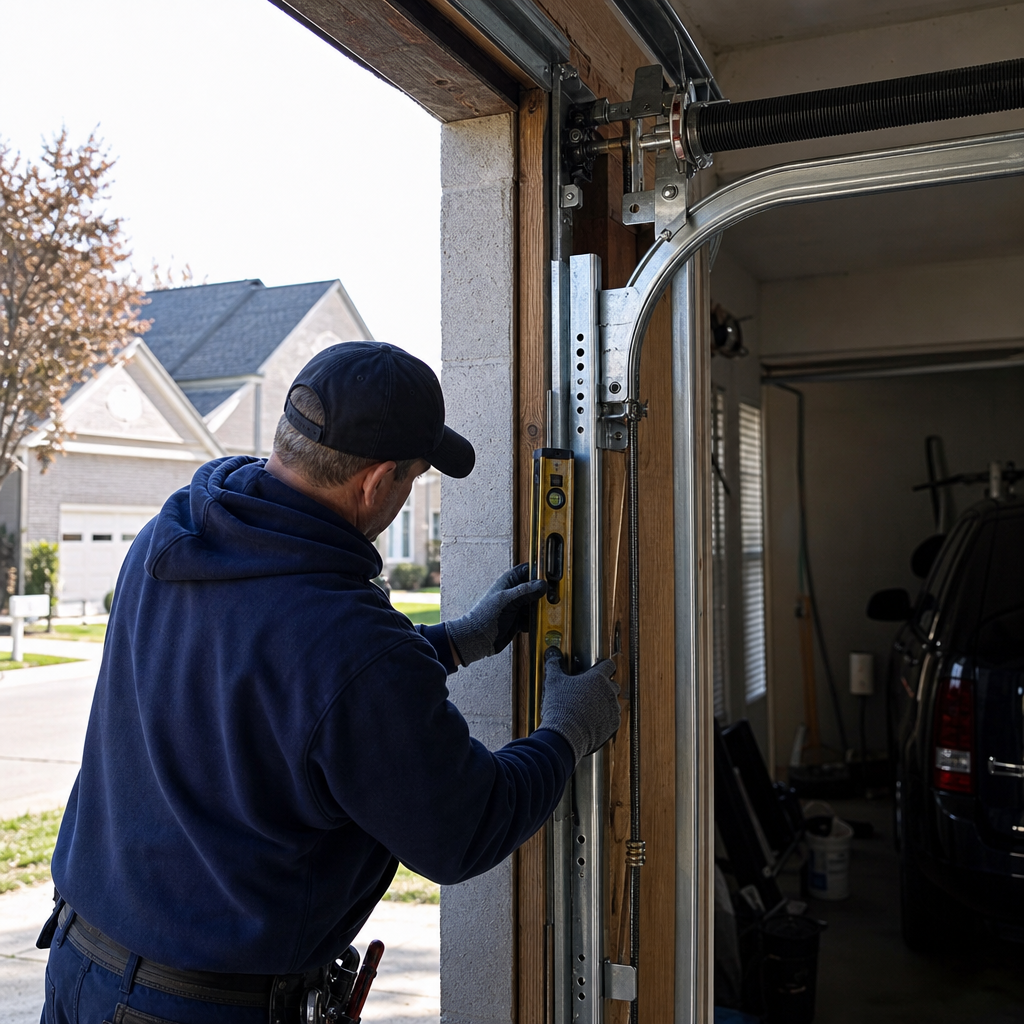
- Visually inspect vertical tracks for plumb using a level — even 1/4-inch out of true causes rollers to bind
- Check for rust bloom on bottom brackets and hinges (Columbus’s hard water accelerates this — see below)
- Test door balance: disconnect opener and lift manually — it should stay at mid-height
- Schedule professional tune-up if balance is off or tracks need adjustment
May–June: Pre-Humidity Preparation
Columbus humidity averages 70% in July but starts climbing in May. Wooden doors in neighborhoods like German Village and Victorian Village — where historic homes often have original carriage-style doors — begin absorbing moisture and swelling.
Apply fresh coat of exterior paint or sealant to wood doors before humidity peaks. For steel doors, inspect for any paint nicks that expose bare metal — summer humidity plus road salt residue equals rapid corrosion.
July–August: Peak Heat Stress
Opener motors work hardest in July. A Genie or LiftMaster unit in an uninsulated Columbus garage can experience internal temperatures exceeding 140°F. Thermal overload sensors trip, and homeowners assume the opener has failed.
- Clean photo-eye sensors — dust and humidity film causes misalignment
- Inspect nylon rollers for flat-spotting from heat-softening
- Verify opener ventilation isn’t blocked by storage items
- Lubricate chain or screw drive with manufacturer-specified grease (not spray lubricant)
September–October: The Critical Window
This is the most important maintenance period in Columbus. Everything you do now prevents January emergencies.
- Full lubrication of torsion springs, hinges, rollers, and bearings with lithium-based grease
- Tighten all hardware — summer expansion loosens bolts
- Replace worn rollers, cables, or weatherstripping while temperatures allow proper material seating
- Test auto-reverse mechanism thoroughly (procedure below)
November–December: Final Prep Before Freeze
Complete any deferred maintenance by Thanksgiving. After December 1, lubricants won’t penetrate properly until March. In our experience serving Columbus since 2006, the week after Thanksgiving is when we see the last rush of preventable tune-ups before winter lock-in.
What You Can Safely DIY vs. What Requires a Technician
We’re straightforward about this because Steven Ramirez has seen the aftermath of DIY attempts that went wrong — and we’d rather you call us before that happens. Here’s the honest boundary.
Safe for Homeowners
- Visual inspection of all components from a safe distance
- Lubrication of hinges, rollers (if not sealed bearing), and door panels
- Testing auto-reverse with a 2×4 or manufactured test block
- Cleaning photo-eye sensors with soft cloth
- Tightening visible lag screws on track mounting brackets (not track bolts themselves)
- Replacing remote batteries and reprogramming remotes
Requires a Trained Technician — No Exceptions
Torsion spring adjustment or replacement. These springs store lethal energy — typically 10,000+ foot-pounds in a standard residential door. Winding bars must be inserted properly; improper tools or technique can cause severe injury or death. We’ve replaced springs in Columbus homes where the previous homeowner’s DIY attempt embedded a winding bar in the garage ceiling.
Cable replacement. Cables are under extreme tension and can whip unpredictably when detached. They also require precise drum winding to maintain door balance.
Track realignment. Tracks must be parallel within 1/4-inch and plumb within precise tolerances. Improper adjustment causes binding, premature roller wear, and opener strain.
Opener motor gear replacement. Internal repairs require specialized tools and calibration.
The rule we give Columbus homeowners: if the repair involves stored mechanical energy (springs, cables, counterbalance system), call a professional. The Garage Door Repair in Columbus page details our diagnostic process.
How to Test Your Auto-Reverse Safety Mechanism
This is the #1 code-compliance failure we find in Columbus homes — and the most dangerous. Federal law (UL 325) requires all automatic garage door openers manufactured after 1993 to have auto-reverse. Yet in our inspections across Franklin County, roughly 30% of doors fail this basic test.
Mechanical Force Test (Monthly)
- Place a 2×4 board flat on the floor centered under the door path
- Close the door using the wall button (not remote)
- The door must reverse within 2 seconds of contacting the board
- If it doesn’t reverse immediately, disconnect opener and call for service — do not use automatic function
Photo-Eye Test (Monthly)
- Start door closing with wall button
- Sweep a broom handle through the beam path while door is moving
- Door must reverse within seconds — if it continues, photo-eyes are misaligned or failed
- Clean lenses with soft cloth; if still failing, alignment or wiring requires professional attention
Columbus’s freeze-thaw cycles knock photo-eyes out of alignment more frequently than in stable climates. We see this constantly in newer subdivisions like Dublin and Powell, where settlement is still occurring.
Reading the Warning Signs: What Worn Parts Look Like Before They Fail
After 20 years in the trade, we can predict failures with surprising accuracy. Here’s what to look for during your monthly inspection.
Torsion Spring Fatigue
A healthy spring has tight, evenly spaced coils with clean edges. As fatigue develops, you’ll see:
- Gap opening between coils: When relaxed, a failing spring shows visible daylight between coils that previously touched — this indicates the steel has stretched and lost temper
- Surface rust with pitting: Columbus humidity causes surface oxidation; once pitting begins, stress concentrates at those points
- Coil distortion: Any visible bend, kink, or non-circular coil shape means replacement is imminent — typically 2–6 weeks
In our Columbus experience, springs installed by builders in developments like Reynoldsburg and Grove City during the 2005–2010 construction boom are now hitting end-of-life in clusters. If your home is in that age range and still has original springs, proactive replacement prevents the 11 PM emergency call.
Cable Fraying
Lift cables show failure progressively. First, individual strands protrude from the cable bundle like whiskers — we call this “blooming.” Next, visible rust staining appears where moisture wicks into the strands. Finally, flat spots develop where the cable has kinked around the drum. Once blooming is visible, replacement should happen within 30 days. A snapped cable converts door weight entirely to one spring, which usually fails catastrophically within hours or days.
Roller Wear
Nylon rollers develop flat spots and cracking; steel rollers show bearing wear as wobble or grinding noise. A roller that doesn’t spin freely when manually turned needs replacement. In Columbus, we see accelerated roller wear from road salt grit that enters the garage on winter tires and abrades roller surfaces.
How Columbus Weather and Hard Water Damage Your Door
This is where generic checklists completely fail Columbus homeowners. Our specific climate and water chemistry create failure modes that don’t exist in Phoenix or Seattle.
The Hard Water Corrosion Pattern
Columbus municipal water averages 140–180 ppm hardness, with some western suburbs exceeding 200 ppm. When homeowners wash cars in driveways or garage floor drains back up slightly, mineral-laden water contacts bottom brackets, hinges, and track hardware. The result isn’t the uniform rust you’d see in a coastal climate — it’s localized, aggressive pitting at bolt heads and weld points.
We see this pattern distinctly in:
- Upper Arlington and Grandview Heights homes with older galvanized hardware
- Properties near the Scioto River with higher groundwater mineral content
- Any home where the garage floor slopes toward the door (trapping moisture at the threshold)
The fix: annual inspection of all hardware for white mineral deposits or unusual rust patterns, plus prompt replacement of affected components with zinc-coated or stainless alternatives.
Humidity Swelling in Historic Neighborhoods
German Village, Victorian Village, and Bexley contain hundreds of original carriage doors or early reproductions with solid wood panels. July humidity in Columbus can push garage interior relative humidity above 85%, causing 1/4-inch or greater expansion in width. Doors that sealed properly in April bind in July, stressing openers and distorting frames.
These doors need:
- Multiple coats of marine-grade sealant on all six sides of panels
- Proper clearance gaps (3/16-inch minimum on each side) that account for seasonal swelling
- Dehumidification in the garage space, not just the home
Wind Load and Storm Frequency
Columbus sits at the intersection of multiple storm tracks. Derecho events like the June 2012 storm create sudden pressure differentials across garage doors. After any severe weather event with winds exceeding 60 mph, inspect for:
- Panel dents or creases (especially in thin-gauge builder-grade doors)
- Track mounting bracket loosening
- Opener arm bracket stress cracking
The Right Lubrication for Columbus Conditions
Product selection matters enormously in our climate. The wrong lubricant becomes a failure accelerator.
| Component | Recommended Product | Frequency | Columbus-Specific Note |
|---|---|---|---|
| Torsion springs | White lithium grease (spray or tub) | October, February | February application only if October was missed; November is the critical window |
| Hinges | White lithium grease | October, April | Check for rust bloom at hinge barrels after winter |
| Roller bearings | Light machine oil (sealed bearings: none) | As needed | Nylon rollers with exposed bearings only; sealed rollers never need lubrication |
| Track interior | None — clean only | Quarterly | Lubricant on tracks attracts grit, causing roller slippage |
| Chain/screw drive | Manufacturer-specified grease | Annually | LiftMaster and Chamberlain specify different products; check manual |
| Weatherstripping | Silicone spray | October | Prevents freezing to concrete; critical in Columbus freeze-thaw |
What to avoid: WD-40 as a lubricant (it’s a solvent and degreaser, not a lasting lubricant); graphite on outdoor components (attracts moisture in Columbus humidity); heavy grease on tracks (collects abrasive grit from road salt and construction).
Common Mistakes to Avoid
- Lubricating the track. We see this constantly. Lubricant on vertical or horizontal tracks creates a sticky film that accumulates road salt, garage dust, and abrasive particles. Rollers slip, then catch, causing jerky operation and opener gear damage. Tracks should be wiped clean with a damp cloth only.
- Ignoring the door balance because “the opener still works.” An unbalanced door forces the opener to do the spring’s job. In Columbus’s cold January mornings, that extra load is what strips nylon gears in Chamberlain and LiftMaster units. The opener is a convenience device, not a lifting system — balance must be correct.
- Using the emergency release improperly. Pulling the red handle with the door open and no one holding it causes free-fall. We’ve responded to calls in Clintonville and Short North where this has damaged vehicles or injured homeowners. Always have the door closed and supported before disengaging the opener.
- Pressure-washing the door. Columbus homeowners often include garage doors in annual house washing. High-pressure water forces moisture into roller bearings, electrical connections, and between panel sections. It also strips protective coatings. Use low-pressure rinse and hand-cleaning only.
- Waiting for total failure. A spring that makes noise in October will break in January — guaranteed, in our experience. The cost difference between scheduled replacement ($200–$350 typically) and emergency service with after-hours premium and potential door damage is substantial. Plan maintenance; don’t react to failures.
- Buying wrong replacement parts online. Springs must be matched to exact door weight and height; cables to drum size and lift type. Generic “garage door spring” listings on major retailers sell products that fit nothing properly. Incorrect springs are dangerous and damage openers.
- Neglecting the exterior keypad. Columbus temperature extremes destroy keypad electronics. Test monthly; replace batteries annually before cold weather. A failed keypad often causes homeowners to override security settings or leave remotes in vehicles.
When to Call a Professional
Call for service when you observe: any visible damage to torsion springs or lift cables; door that won’t stay at mid-height when manually tested; opener that strains, reverses unexpectedly, or makes grinding noises; tracks visibly out of plumb or with dents; auto-reverse failure on either mechanical or photo-eye test; or any event where the door has been struck by a vehicle or heavy object.
After two decades of hands-on experience, we’ve found that Columbus homeowners who schedule professional inspection every 12–18 months avoid nearly all emergency failures. Empire Garage Door Installation Columbus home offers free estimates in Columbus — call (877) 502-2559 to schedule. Steven Ramirez personally evaluates every door, and we work on all major brands including LiftMaster, Chamberlain, Genie, and Clopay systems.
Frequently Asked Questions
Professional tune-up service in the Columbus market typically ranges from $89–$150 for a standard residential door, depending on door size, opener type, and whether spring tension adjustment is needed. This generally includes full safety inspection, balance test, hardware tightening, lubrication, and auto-reverse verification. Call (877) 502-2559 for an exact quote — estimates are free.
You can safely handle visual inspections, lubrication of accessible components, sensor cleaning, and basic hardware tightening. However, torsion spring work, cable replacement, track realignment, and opener internal repairs require specialized training and tools — these present genuine injury risk and should never be DIY projects. We’ve seen the consequences of attempts that went wrong across Franklin County.
Test monthly using both the mechanical force method (2×4 board) and the photo-eye interruption test. This takes under two minutes and is the most important safety check you can perform. In Columbus, photo-eyes are particularly prone to misalignment from freeze-thaw foundation movement, so monthly verification is essential.
Cold temperatures cause steel components to contract and lubricants to thicken. The most common winter noise source is a dry torsion spring binding against itself as coils tighten. Lubrication in October prevents this. If noise persists after lubrication, spring fatigue or worn rollers are likely — schedule inspection before failure occurs.
For doors under 15 years old with isolated component failure (single spring, one panel, opener malfunction), repair is typically more economical. Replacement becomes cost-effective when: the door has multiple failed components, panels are damaged or rusted through, insulation value is inadequate for your needs, or you want updated safety features and curb appeal. Garage Door Installation in Columbus covers replacement considerations in detail — we provide honest assessments with no pressure to upgrade unnecessarily.
Emergency garage door service is available for urgent failures — doors that won’t close and secure the home, vehicles trapped inside, or safety hazards like hanging cables. Response time varies by location and current call volume, but we prioritize genuine emergencies and maintain availability beyond standard hours when your door can’t wait. Call (877) 502-2559 for current availability.
The Bottom Line
Effective garage door maintenance in Columbus isn’t about following a generic checklist — it’s about anticipating what central Ohio weather does to your specific door and acting before failure forces your hand. The October lubrication, the monthly auto-reverse test, the honest assessment of whether that noise means two weeks or two months remaining: these habits separate homeowners who never think about their door from those making 11 PM emergency calls in January. With two decades of hands-on experience and nearly 800 verified reviews, we’ve learned that prevention is always less expensive than reaction. Use this calendar, respect the boundary between safe DIY and professional work, and your garage door will operate reliably through every Columbus season.
Written by Steven Ramirez, Owner & Lead Technician at Empire Garage Door Installation Columbus, serving Columbus since 2006.